
7 Easy Ways to Balance Pool Water Without the Mess
Last Updated: October 28, 2026
Quick Summary
To balance pool water, test free chlorine, pH, total alkalinity and cyanuric acid, then adjust each reading into its ideal range in the right order. Keep free chlorine at 1-3 ppm, pH at 7.4-7.6, total alkalinity at 80-120 ppm and cyanuric acid at 30-50 ppm, and space out each chemical addition so circulation can catch up.
- Test free chlorine, pH, total alkalinity and cyanuric acid with Crystal Blue 4-in-1 Test Strips, 20 strips per bottle.
- Low free chlorine lets algae and bacteria survive, while high levels cause irritation and faded liners.
- Low total alkalinity means pH swings daily; high total alkalinity locks pH and forms scale.
- Space each chemical adjustment out instead of adding chemicals back-to-back without waiting for circulation.
- Crystal Blue Phosphate Test Strips test phosphate levels up to 2500 ppb, with 25 strips per box.
Table of Contents
- Why Water Balance Matters More Than You Think
- How to Test and Balance Pool Water in Four Quick Checks
- The Pool Chemical Balancing Order That Saves You Time
- Ideal Pool Water Chemistry Levels at a Glance
- How Long to Wait After Adding Pool Chemicals
- How to Fix the Most Common Pool Water Imbalances
- Stock Your Pool Care Kit with Crystal Blue
- Frequently Asked Questions
Why Water Balance Matters More Than You Think
Clear water isn't the same as balanced water. That distinction sits at the heart of every easy way to balance pool water we cover here.
Here's the core tension. Most pool advice treats balancing as a long list of separate chores. In practice, water balance is one connected system.
So why does this matter more than most owners realize?
The good news: you don't need a chemistry degree. You need a repeatable routine and test results you actually trust.
How to Test and Balance Pool Water in Four Quick Checks
To test pool water, check free chlorine, pH, total alkalinity and cyanuric acid.
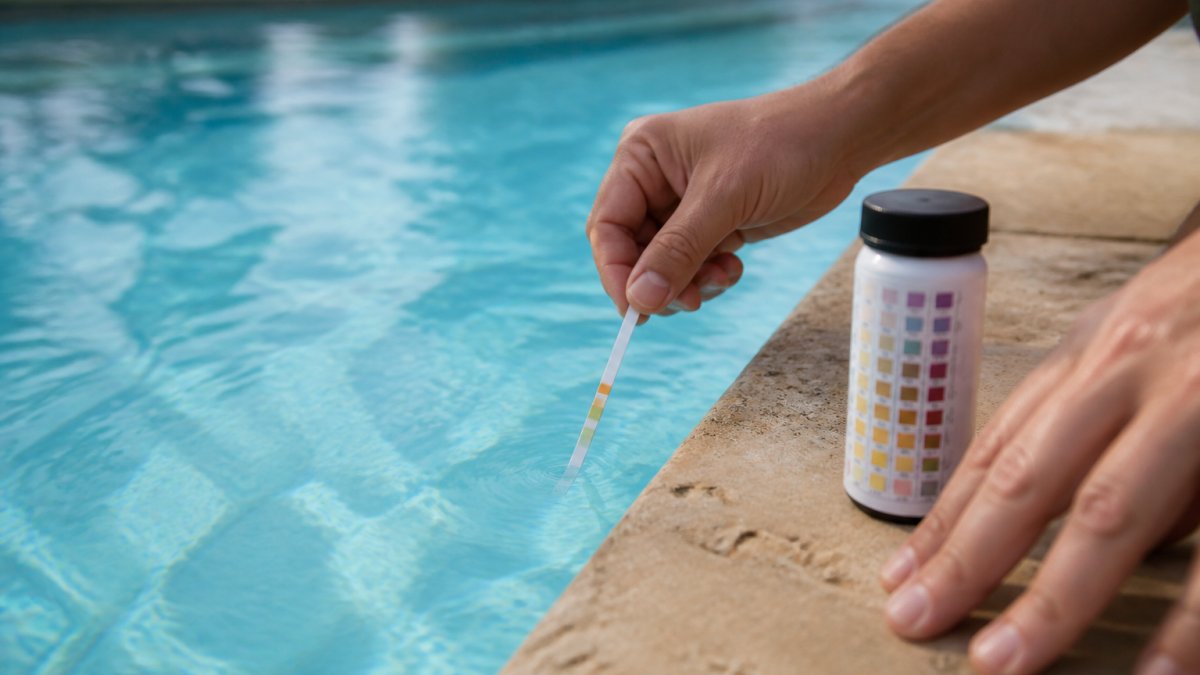
Our Crystal Blue 4-in-1 Test Strips test free chlorine, pH, total alkalinity and cyanuric acid. Each bottle contains 20 strips.

The Pool Chemical Balancing Order That Saves You Time
What most guides miss is that phosphate removers work best in stable water. Add them mid-adjustment and you waste product while the chemistry shifts underneath you. Dosing errors compound the same way, which is why our guide to 7 pool chemical dosing mistakes to avoid pairs naturally with this sequence.
Ideal Pool Water Chemistry Levels at a Glance
| Reading | Ideal Range | What Happens When It's Off |
|---|---|---|
| Free chlorine | 1-3 ppm | Low: algae and bacteria survive. High: irritation and faded liners |
| pH | 7.4-7.6 | Low: corrosion and stinging eyes. High: cloudy water, weak chlorine |
| Total alkalinity | 80-120 ppm | Low: pH swings daily. High: pH locks and scale forms |
| Cyanuric acid | 30-50 ppm | Low: chlorine burns off fast. High: chlorine loses potency |
| Phosphates | As low as practical | High: algae has a food source |
Check the Centers for Disease Control and Prevention guidance on pool water quality for the public health reasoning behind chlorine and pH targets. It explains why these ranges exist rather than just what they are.
How Long to Wait After Adding Pool Chemicals
Watch out: adding chemicals back-to-back without waiting for circulation is the fastest route to cloudy water and wasted product. Space each adjustment out. Our guide to fast dissolving pool chemicals for beginners explains how quickly different formulations mix so you can plan the gaps.
Crystal Blue 4-in-1 Test Strips →
How to Fix the Most Common Pool Water Imbalances
If cloudiness persists, our guide on how to clear cloudy pool water discusses the topic.
The Pool Water Chemistry basics from the American Chemistry Council explain how these readings interact, which helps you spot the root cause instead of treating symptoms.
Phosphates deserve their own mention. Crystal Blue offers phosphate test strips and phosphate remover products.
Stock Your Pool Care Kit with Crystal Blue
Crystal Blue offers solid chemical formulations with rapid dissolution technology, designed to simplify application and reduce spills and overdosing. They are compatible with various filtration systems.
Crystal Blue offers:
- 4-in-1 Test Strips for free chlorine, pH, total alkalinity and cyanuric acid.
- Phosphate Test Strips to test phosphate levels up to 2500 ppb; each box contains 25 strips.
- Phosphate Remover Boost Granules - 1 Pouch.
- Phosphate Remover Tablet Home Care Pack - 3 Tablets.
Test first, then treat. If you have questions, the Crystal Blue FAQ covers details before you buy.
Frequently Asked Questions
What should I adjust first when balancing pool water?
Test alkalinity and pH with Crystal Blue 4-in-1 Test Strips.
How long should I wait to retest pool water after adding chemicals?
Wait at least 4 hours of circulation before retesting pH, alkalinity or chlorine, and give granular or tablet products a full 24 hours before judging the result. Never retest immediately after dosing, because the chemical has not dispersed yet and you will read a false number. Run the pump the whole time. For a full reset, dose, circulate overnight, then test the next morning with fresh strips.
Can I swim right after adding pool chemicals?
Not immediately. Wait until the product has fully dissolved and the pump has circulated for at least 30 minutes to an hour, and confirm free chlorine sits between 1 and 3 ppm before anyone gets in. Solid formulations dissolve faster than liquid doses disperse evenly, but the safe rule is the same: no swimming while undissolved product is visible or chlorine reads above 5 ppm.
Do solid pool chemicals work in a small above-ground pool?
Yes. Solid formulations dissolve in the water regardless of pool size, and they work with basic cartridge and sand filter systems as well as larger in-ground setups. The main adjustment is dose size: a smaller pool needs less product, so start with a partial dose, circulate, and retest before adding more. Pre-measured tablets and pouches make that easier than pouring liquid by eye.
Balancing pool water doesn't have to mean spills, guesswork or a shelf of half-used liquids. It means testing four readings, adjusting in the right order, and using formulations that dissolve cleanly. Crystal Blue makes that simpler with solid chemicals built for rapid dissolution, phosphate reduction and fewer backwashing headaches. Get started with Crystal Blue and stock a pool care kit that keeps your water clear without the mess.
